Case studies · the research notebook

Inside the experiments.

What happens when exact AI state meets a real workload? Explore the builds, the measurements and the decisions that followed.

Two experiments. Open results.

01 — 02 / Independent research
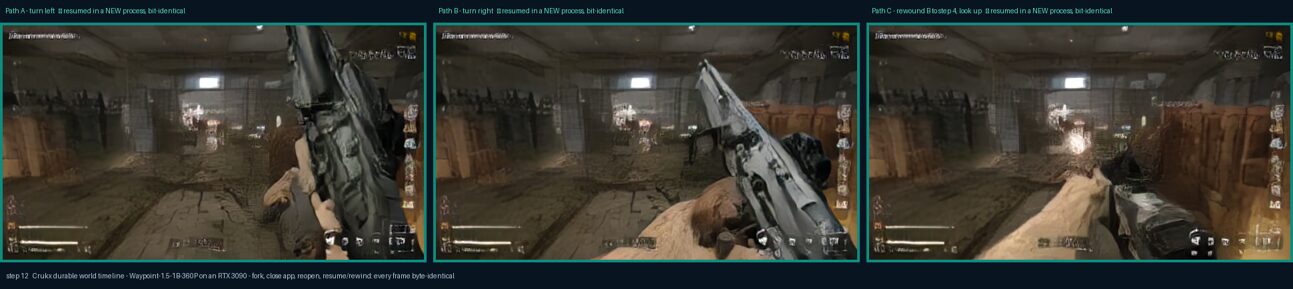
Generated world timeline from the Waypoint experiment Save → fork → reopen
One world.Three futures.
Overworld’s open Waypoint model · RTX 3090
01 / Inference stateExact reopening

Durable world timelines on an open world model

Save a generated world, fork its future, close the app and come back. We tested whether the reopened world could continue with every frame identical.

Saved timeline
17 points
Verification
Frame hashes

Independent implementation on Overworld’s open release. Same-machine exactness; not an Overworld deployment or endorsement.

Read the Overworld case study
E2.1 / Concurrent training
Training throughput loss ↓
Crukx CBP1 /1015.28%
PyTorch DCP /1007.18%
One RTX 3090 · 3.225M parameters · adaptive cadence follow-up
02 / Training stateImplementation parked

Why we parked our async checkpoint prototype

Restoration was exact. Under concurrent training, a cadence adjustment let PyTorch DCP outperform our whole-copy GPU prototype. We preserved the evidence and stopped scaling that design.

Timed runs
53
Restore checks passed
43 / 43

Single-GPU diagnostic. Includes the original cadence comparison, the adaptive follow-up, methods and a downloadable report.

Read the DCP case study

Every study states what ran, what we checked and where the result stops applying.

Explore storage and lineage benchmarks